Want an overview?
Click this icon to view a list of sections and pages.

Want to know more?
Click these icons to see recommended literature or detailed additional information.

Lost track of where you are?
Use these buttons to navigate step-by-step through the training.

You can also navigate using your mouse or touchscreen.
Click on the video to play or pause.
You are currently viewing a placeholder content from YouTube. To access the actual content, click the button below. Please note that doing so will share data with third-party providers.
More InformationKids often believe that certain professions are only for certain genders, and they could think it's impossible or not allowed for a boy to grow up to work in a 'female' job.
As adults we might think it's kind of cute. But that pattern of behavior has nothing to do with age.
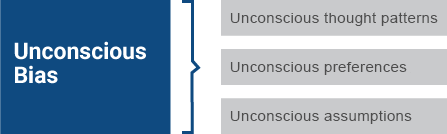
We all base our actions on our past experiences – which means we subconsciously develop preferences and expectations without checking for alternatives. In short: our subconscious thought patterns steer us through many situations.
See for yourself …
When we try to assess or judge a person, we often unconsciously draw on outward appearance and assumptions. Without our even being aware, we run the risk of excluding people who don't fit the "labels" we give them.
Let's take a closer look at this phenomenon:
Pay close attention as you watch this next video. There'll be a quiz afterward.
Click on the video to play or pause.

You are currently viewing a placeholder content from YouTube. To access the actual content, click the button below. Please note that doing so will share data with third-party providers.
More InformationClick on the correct answer.
2 buses
3 buses
Click on the correct answer.
For us to be able to take action despite this flood of information, our brain needs to filter and sort everything quickly.
To do that it accesses a kind of template, i.e.
Take a deep breath and then start this little math exercise. You have 20 seconds to submit your answer. Ready?
A baseball bat and a ball together cost $ 1.10. The bat costs exactly $ 1 more than the ball..
Click on the correct answer.
1 dollar
10 cents
5 cents
Take the Chefsache test and find out how closely you associate, e.g., the words 'career' and 'female'.
More than 80,000 similarly structured implicit association tests at the Harvard University have shown that:
Almost all of us have subconscious preferences, which makes us biased on the subject of careers.
All human beings take mental shortcuts. It's how we've evolved and it helps us process our complex world.
In short: in certain situations we're all subject to unconscious biases.
We categorize so that we can make quick decisions. What's important is that we recognize when subconscious thought patterns are steering us toward bad decisions.
In our work lives, unconscious bias mainly comes into play when we try and assess someone's skills and or preferences. It can emerge either consciously or subconsciously, and often manifests as stereotypes or prejudice.
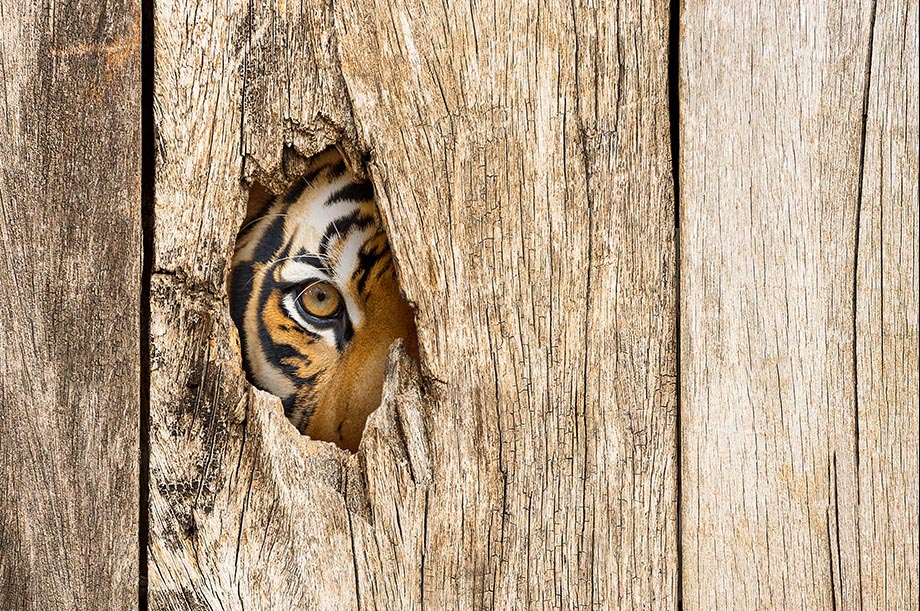
From an evolutionary standpoint, this has always been an incredibly important function of our brain, if not one that is essential to our survival. For example, we tend to flee when we perceive a threat – even if it later turns out that the rustling sound in the grass was caused by something other than a dangerous predator.
Nobel Prize winner and psychologist Daniel Kahneman referred to our fast-thinking mode as "System 1". System 1 thinking is fast and automatic, i.e., subconscious. It is always active and mainly involves emotions and stereotypes. "System 2" works slower since it applies logical filters. It's in this mode that we can deliberately control our thought patterns. However, we find it more difficult to make decisions in System 2. Our math exercise showed how we use System 1 to pick the most readily available solution, even though it might be wrong.
If we are subject to an unconscious bias, it means we're in fast-thinking mode and potentially making bad decisions subconsciously. So how do we make sure we don't take mental shortcuts when it really counts, but rather take a deep breath and switch to System 2? That's what you'll learn in this training.
Source:
Kahneman, D. (2011).
Thinking, Fast and Slow..
Farrar, Straus and Giroux.
The Chefsache test is similar in structure to Harvard University's implicit association test (IAT). Both tests measure how quickly you associate words in the categories of career and family'.
Most respondents associate male words with 'career' and female words with 'family'. We can see this from the fact that words linked to the combinations of male/career and female/family are processed quicker than those for the combinations of male/family and female/career.
For further information:
https://implicit.harvard.edu/implicit/
You are currently viewing a placeholder content from Facebook. To access the actual content, click the button below. Please note that doing so will share data with third-party providers.
More InformationYou are currently viewing a placeholder content from Instagram. To access the actual content, click the button below. Please note that doing so will share data with third-party providers.
More InformationYou are currently viewing a placeholder content from reCAPTCHA. To access the actual content, click the button below. Please note that doing so will share data with third-party providers.
More InformationYou are currently viewing a placeholder content from X. To access the actual content, click the button below. Please note that doing so will share data with third-party providers.
More Information